2021-09-05
September 4, 2021 blue; text-decoration: blue; text-decoration: none;”>34th edition of the 9th year of SmartDrivingCars eLetter
In a patch of Arizona, everyone knows Waymo. But few use it.
R. Duffy, Aug 23, “Chandler, Arizona, is a city of just over 250,000 that’s located southeast of Phoenix. Like most of Arizona, it’s hot, dry, and lined with cacti and palm trees.
                                                      But unlike
                                                      most of
                                                      Arizona—or
                                                      virtually
                                                      anywhere else
                                                      in the
                                                      world—Chandler
                                                      residents
                                                      share the road
                                                      with fully
                                                      driverless
                                                      robotaxis,
                                                      courtesy of
                                                      Waymo. As
                                                      Stacy, a
                                                      Chandler
                                                      resident, told
                                                      us, "Waymos
                                                      are like
                                                      rabbits in my
                                                      neighborhood."

                                                      Since October
                                                      2020, the
                                                      Alphabet
                                                      subsidiary has
                                                      been running
                                                      its driverless
                                                      ride-hail
                                                      service, Waymo
                                                      One, in a
                                                      50-square-mile
                                                      service area
                                                      that
                                                      encompasses
                                                      parts of
                                                      Chandler,
                                                      Tempe, Mesa,
                                                      and Gilbert.
                                                      Anyone with a
                                                      smartphone,
                                                      credit card,
                                                      and GPS
                                                      coordinates in
                                                      the service
                                                      area can hail
                                                      a completely
                                                      driverless
                                                      ride of their
                                                      own.
In December 2018, Waymo opened Waymo One (with safety drivers) to the general public, expanding beyond an early rider program available to pre-approved, NDA-bound Phoenix residents. The company’s current testing zone, for driverless and safety operator-supervised vehicles, stretches across roughly 100 square miles.
                                                      And although
                                                      residents
                                                      living in or
                                                      near the
                                                      service area
                                                      may be used to
                                                      seeing Waymo's
                                                      glossy-white,
                                                      sensor-laden
                                                      Chrysler
                                                      Pacificas
                                                      roving around,
                                                      the chances
                                                      they've ridden
                                                      in one are
                                                      much, much
                                                      lower. .."  [Read more](https://www.morningbrew.com/emerging-tech/stories/2021/08/23/patch-arizona-everyone-knows-waymo-use) As I've been writing, Chandler is a great place to
                                                      test
                                                      Driverless
                                                      mobility to
                                                      make sure it
                                                      at least
                                                      begins to
                                                      work; however,
                                                      the value in
                                                      the technology
                                                      is not as
                                                      amusement or
                                                      thrill ride or
                                                      as circus
                                                      sideshow.  The
                                                      value is its
                                                      ability to
                                                      affordably
                                                      deliver high
                                                      quality
                                                      on-demand
                                                      mobility.  It
                                                      will be a long
                                                      time before it
                                                      can provide a
                                                      higher quality
                                                      of service
                                                      that a
                                                      chauffeured
                                                      "Black car" or
                                                      limousine, so
                                                      it can't
                                                      compete for
                                                      those
                                                      traveling on
                                                      an expense
                                                      account or the
                                                      well to do.
                                                      It also can't
                                                      really compete
                                                      to serve the
                                                      Drive-it-Yourself
                                                      (DiY) folks
                                                      that can
                                                      afford to buy
                                                      their own cars
                                                      and park them
                                                      for free when
                                                      not in use.
                                                      Conventional
                                                      mobility
                                                      serves all of
                                                      these folks
                                                      very well.
Where this form of mobility has a real advantage is to serve folks who are required to conform to mobility whose very limited service is provided on a “take-it-or-leave-it” operational philosophy. Services that operate between few fixed locations at strictly stipulated times specified by the service provider. The disparity in service is incredible between mobility options that respond directly to customer needs in terms of from/to/when (walking, DiY personal car, Uber/Lyft/taxi/limousine/WaymoOne) and public transit’s “take-it-or-leave-it” customer service approach.
Consequently, Waymo’s market opportunity is in places where customer demand is by folks who can’t DiY and aren’t on an expense account and can’t afford Uber/Lyft/taxi/limousine. Places like Trenton, New Jersey where 70% of the households have at most one car as opposed to Chandler where 70% of households have two or more cars. In Chandler, Waymo has to go far and wide (“50 sq. mi.) to find customers for which the Waymo One service is indeed better than what they already enjoy. In cities like Trenton, those folks exist in a compact 8 sq. mi. area. Seems like a no-brainer that Waymo Two should be in Trentons. Alain
SmartDrivingCars
                                                      [Pod-Cast Episode 232](https://anchor.fm/smartdrivingcars/episodes/Smart-Driving-Cars-Episode-232-Can-cameras-alone-get-to-driverless-mobility-e16tilm)[,](https://soundcloud.com/smartdrivingcar/smart-driving-cars-230-with-tim-higgins-author-of-power-play) [Zoom-Cast Episode 232](https://www.youtube.com/watch?v=PeGxqFemSWw)
                                                      w [Steven Shladover](https://path.berkeley.edu/steven-e-shladover)
###
F. Fishkin, Sept. 4 “Cameras alone aren’t enough to get Tesla or anyone else to driverless mobility. So says UC Berkeley’s Steven Shladover, a leading autonomous vehicle research engineer. He joins Princeton’s Alain Kornhauser and co-host Fred Fishkin for that plus the need for more regulation from Washington, Waymo, Cruise, Toyota, Motional and more. Watch or listen to Smart Driving Cars Episode 232 and subscribe!”
                                                      The
                                                      SmartDrivingCars
                                                      eLetter,
                                                      Pod-Casts,
                                                      Zoom-Casts and
                                                      Zoom-inars are
                                                      made possible
                                                      in part by
                                                      support from
                                                      the Smart
                                                      Transportation
                                                      and Technology
                                                      ETF, symbol
                                                      MOTO.   For
                                                      more
                                                      information: [www.motoetf.com](https://www.smartetfs.com/).  Most funding is
                                                      supplied by
                                                      Princeton
                                                      University's
                                                      Department of
                                                      Operations
                                                      Research &
                                                      Financial
                                                      Engineering
                                                      and Princeton
                                                      Autonomous
                                                      Vehicle
                                                      Engineering
                                                      (PAVE)
                                                      research
                                                      laboratory as
                                                      part of its
                                                      research
                                                      dissemination
                                                      initiative
Surging crash-death rates that took hold with pandemic continued this year, according to new estimate
I. Duncan, Sep 2, “The first quarter of 2021 was the deadliest start of a year on the nation’s roads in over a decade, with car crashes killing an estimated 8,730 people from January to March, according to a new estimate from the National Highway Traffic Safety Administration.
                                                      The numbers
                                                      indicate that
                                                      a surge in
                                                      road deaths
                                                      that began
                                                      with the
                                                      coronavirus
                                                      pandemic has
                                                      continued into
                                                      this year,
                                                      although they
                                                      offer some
                                                      early glimmer
                                                      of hope that
                                                      unusually high
                                                      fatality rates
                                                      might be
                                                      beginning to
                                                      come down.

                                                      NHTSA said the
                                                      ongoing high
                                                      death rate
                                                      appears to
                                                      have been
                                                      caused by
                                                      drivers
                                                      continuing to
                                                      take risks by
                                                      speeding,
                                                      getting behind
                                                      the wheel
                                                      after drinking
                                                      or using
                                                      drugs, and not
                                                      wearing seat
                                                      belts. To
                                                      coincide with
                                                      the new
                                                      estimates,
                                                      NHTSA on
                                                      Thursday
                                                      released an
                                                      updated
                                                      version of a
                                                      guide to
                                                      improving
                                                      highway
                                                      safety,
                                                      largely
                                                      focusing on
                                                      encouraging
                                                      more-conscientious
                                                      behavior on
                                                      the roads and
                                                      deterring
                                                      risk-taking..."
                                                      [Read more](https://www.washingtonpost.com/transportation/2021/09/02/road-crash-deaths-spring-2021/)  [See NHTSA Early Estimate of Motor Vehicle Traffic Fatalities for the First Quarter of 2021 announcement](https://www.nhtsa.gov/sites/nhtsa.gov/files/2021-09/Early-Estimate-Motor-Vehicle-Traffic-Fatalities-Q1-2021.pdf).
                                                      Roughly a 25%
                                                      increase in
                                                      death rate for
                                                      Q1s (from
                                                      ~1.0/100MxVMT
                                                      to 1.26/100MxVMT.  Seems
                                                      as if NHTSA is
                                                      going to have
                                                      to do more
                                                      than "... release(d) an updated version of a guide ...".
                                                      There are now
                                                      so many
                                                      speeders and
                                                      texters out
                                                      there and
                                                      there aren't
                                                      enough traffic
                                                      cops to do
                                                      anything about
                                                      it.  If
                                                      driving is
                                                      really a
                                                      privilege,
                                                      then NHTSA
                                                      will need to
                                                      insist that
                                                      technology be
                                                      used to
                                                      enforce the
                                                      common good
                                                      associated
                                                      with that
                                                      privilege.
                                                      Alain
This letter is to inform you that the Office of Defects Investigation…
G. Mango, Aug. 31, “This letter is to inform you that the Office of Defects Investigation (ODI) of the National Highway Traffic Safety Administration (NHTSA) has opened a Preliminary Evaluation (PE21-020) to investigate crashes involving first responder scenes and vehicles manufactured by Tesla, Inc. (Tesla) that were operating in either Autopilot or Traffic Aware Cruise Control leading up to the incident, and to request certain information.
This office is aware of twelve incidents where a Tesla vehicle operating in either Autopilot orTraffic Aware Cruise Control struck first responder vehicles / scenes, leading to injuries and vehicle damage. In each case, NHTSA has reviewed the incidents with Tesla. A list of the twelve incidents has been included for reference.
Please repeat the applicable request verbatim above each response. After Tesla’s response to each request, identify the source of the information and indicate the last date the information was gathered….
Tesla’s response to this letter, in duplicate, together with a copy of any confidentiality request, must be submitted to this office by Friday, October 22, 2021.” Read more Whew! Unfortunately it doesn’t seem to ask anything about the Automated Emergency Braking System and doesn’t explicitly ask how Tesla treats stationary objects that are detected ahead. Can’t wait to see their response. I sure hope NHTSA makes it available to all ASAP without us needing to file Freedom of Information requests. Alain
‘A very big deal’: Federal safety regulator takes aim at Tesla Autopilot
R. Mitchell, Aug 31, “Recent moves by the top U.S. automotive safety watchdog could change the way Tesla markets its cars’ advanced driver-assist capabilities – or force the company to recall the software altogether.” Read more Elon’s “ace in the hole” here is his “over-the-air-updating” capability whereby he can readily and inexpensively satisfy NHTSA demands. He can also afford to give owners a choice of a refund or a software upgrade/fix. The “80/20 rule” would suggest that 80% will happily take the upgrade/fix, even if it includes a rename to “StupidSummon/PayAttention/EmptySelfDriving/…” 😉 Alain
Toyota pauses self-driving ‘e-Palette’ service after one crashed into an Olympic athlete
A. Hawkins, Aug 27, “Toyota has halted its autonomous shuttle service in Tokyo’s Olympic village after one of its vehicles collided with a visually impaired athlete, Reuters reported. Technically, the vehicle was not driving autonomously but was under manual control at the time of the incident.
Toyota had
been operating
dozens of its
"e-Palette"
shuttles
during the
Olympics as a
demonstration
of a far-out
concept the
company first
showed off in
2018. Back
then, the
automaker said
its
e-Palettes,
which are
modular
battery-electric
vehicles
without
traditional
controls like
steering
wheels or
pedals, could
operate either
as
ride-hailing
shuttles or
mobile retail
spaces.
Toyota saw the
Olympics as an
opportunity to
demonstrate
its new
technology.
The boxy
vehicles were
being used by
athletes and
Olympics staff
for months
prior to the
start of the
summer games.
But that came
to an end this
week, after
one of the
vehicles
slammed into
an athlete
that was set
to compete in
the Paralympic
Games.
According to
Reuters, the
shuttle was at
a
T-intersection
when it turned
into the
athlete at a
speed of 1-2
kilometers-per-hour.
The vehicle
was under
manual control
at the time,
with a human
operator using
the joystick
control. The
athlete was
taken to a
nearby medical
center for
treatment and
was able to
walk back to
their
residence.
Toyota CEO
Akio Toyoda
acknowledged
the crash in a
video posted
to YouTube.
"It shows that
autonomous
vehicles are
not yet
realistic for
normal roads,"
he said,
according to
Reuters.." [Read more](https://www.theverge.com/2021/8/27/22644496/toyota-epalette-autonomous-shuttle-crash-halt-olympics) Maybe it is time for these vehicles to stop being
Circus
Sideshows with
human
overseers
using
joysticks.
Alain
Is a self-driving car smarter than a seven-month-old?
Sep. 4, “BY THE AGE of seven months, most children have learned that objects still exist even when they are out of sight. Put a toy under a blanket and a child that old will know it is still there, and that he can reach underneath the blanket to get it back. This understanding, of “object permanence”, is a normal developmental milestone, as well as a basic tenet of reality.
It is also something that self-driving cars do not have. And that is a problem. Autonomous vehicles are getting better, but they still don’t understand the world in the way that a human being does. For a selfdriving car, a bicycle that is momentarily hidden by a passing van is a bicycle that has ceased to exist.
This failing is basic to the now-widespread computing discipline that has arrogated to itself the slightly misleading moniker of artificial intelligence (AI). Current AI works by building up complex statistical models of the world, but it lacks a deeper understanding of reality. How to give AI at least some semblance of that understanding—the reasoning ability of a seven month-old child, perhaps—is now a matter of active research…” Read more Hmmmm… Interesting and well worth reading article; however, it is not quite the case that the automated driving perception systems don’t have an understanding of “object permanence”.
I must admit that back in the 2005 DARPA Grand Challenge, we took “object permanence” to an extreme that actually killed us. We went through great care to place a position vector as well as a velocity vector on every object we encountered. Unfortunately, we failed to include the one line of code to forget the objects after a sufficiently long period of time. So, you guessed it… after 9.8 miles and the accumulation of the description, position and velocity labels on about 250,000 objects, we blew out memory and were disqualified. We went back to our vehicle, Prospect Eleven (that we had abandoned under a large solar panel, UNLV), during Fall Break three weeks later. We discovered our memory leak, fixed one line of code, and basically ran the entire 2005 course, the 2004 course and Beer Bottle pass 3 more times, once at night in the dark (We basically had only GPS and vision sensors, no LiDAR (couldn’t afford it)).
What we learned was that “forgetting/moving-on” is also important. Talk with any hockey goal tender. 😉 Alain
Global Plug-In Car Sales July 2021: Almost Doubled To 480,000
M. Kane, Sep. 2, “3 million new plug-ins were sold so far this year. Global passenger plug-in electric car sales increased in July by 94% year-over-year to about 480,000, which is one of the best monthly results ever. The market share amounted to 7.1%, and two-third of the plug-ins happen to be all-electric.
                                                      Plug-in market
                                                      share improved
                                                      to 7.1%,
                                                      including:

                                                      BEVs: about
                                                      318,000 and
                                                      4.7% share

                                                      PHEVs: about
                                                      162,500 and
                                                      2.4% share

                                                      Total: 480,506
                                                      (up 94%
                                                      year-over-year)
                                                      and 7.1% share
                                                      "
The top-selling models for the month were: Wuling Hong Guang MINI EV (30,706), Tesla Model 3 (18,811) and Tesla Model Y (14,660), Volkswagen ID.4 (14,660) and BYD Qin Plus (PHEV) (9,127).Read more Hmmmm… Not bad! Alain
Los Angeles is about to get its first robotaxi test fleet
R. Mitchell, Aug 31, “If you’ve driven around the Bay Area lately, there’s a good chance you’ve spotted a driverless test car sharing the highway, a whirling lidar array atop its roof. Not so much in the Southland. Little robot car testing has been conducted in Southern California to date.
                                                      That will
                                                      change soon.
                                                      Driverless car
                                                      technology
                                                      company
                                                      Motional
                                                      announced
                                                      Tuesday that
                                                      it will deploy
                                                      "in the near
                                                      term" a test
                                                      fleet of new
                                                      Hyundai Ioniq
                                                      5 electric
                                                      cars in and
                                                      around Los
                                                      Angeles,
                                                      fitted with
                                                      its robotaxi
                                                      technology...
Asked what special challenges Los Angeles will present to robot car development, Iagnemma’s answer was unsurprising: “congestion.”
                                                      He added that
                                                      because Los
                                                      Angeles boasts
                                                      such a
                                                      colorful car
                                                      culture, "it's
                                                      gotta be a
                                                      place where
                                                      you can watch
                                                      a robotaxi
                                                      cruise by.""
                                                      [Read more](https://www.latimes.com/business/story/2021-08-31/hyundai-electric-robotaxi-test-cars-set-to-hit-the-road-in-la) Amazing... I guess that these companies do believe
                                                      that they are
                                                      Circus
                                                      Sideshow
                                                      Attractions.
                                                      Not about
                                                      their mobility
                                                      opportunities,
                                                      but their
                                                      freakishness.
                                                      The reason for
                                                      congestion in
                                                      LA is because
                                                      essentially
                                                      everyone is a
                                                      DiY.  Good
                                                      luck at being
                                                      an early
                                                      disrupter in
                                                      that market.
                                                      Alain
###
###
Why Are Uber And Lyft So Expensive Right Now?
N. Spector, Aug 23, “In mid-June, I embarked on my first air travel since before the pandemic. I planned to just take an Uber to the airport, figuring it was worth it to spare my husband the stress of taking time off work to drive me. Then I saw the estimated cost for the ride: $89 — to drive 10 miles. I’m used to rolling my eyes at inflated fares during rush hour and late nights, but this was more than double the pre-tip amount I’d paid before the pandemic….” Read more At some point the investors are going to stop subsidizing your ride-hail and economic realities will prevail. Alain
Here’s the robotaxi that will be available on the Lyft app in 2023
A. Hawkins, Aug 31, “Motional, the autonomous vehicle company that is a joint venture between Hyundai and Aptiv, revealed more details about its forthcoming robotaxi as well as some of the first images of the vehicle. The company is also working with Lyft and says that by 2023, customers in certain cities will be able to hail rides in this vehicle using the Lyft app…” Read more OK. But will it be available in sufficient quantity in time to save Lyft? Again, for Lyft/Uber to justify their market cap, their platform has to serve more than 10x the number of person trips they currently serve or get 10x the revenue to Lyft, post an adequate take by the gig worker, from each person trips they currently serve. Alain
[Andreessen
Horowitz-backed autonomous-driving software firm Cyngn files for IPO](https://seekingalpha.com/news/3737326-andreessen-horowitz-backed-autonomous-driving-software-firm-cyngn-files-for-ipo)
J. Kronenberg, Sep. 3, “Cyngn (NYSE:CYN), an autonomous-driving software firm backed by Andreessen Horowitz and other A-list venture-capital firms, filed paperwork Friday for an IPO at an unspecified valuation.
                                                      The company
                                                      wrote in an [S-1 filing](https://www.sec.gov/Archives/edgar/data/1874097/000121390021046495/fs12021_cyngninc.htm)
                                                      with the U.S.
                                                      Securities and
                                                      Exchange
                                                      Commission
                                                      that it aims
                                                      to raise some
                                                      $36M from the
                                                      initial public
                                                      offering,
                                                      although
                                                      that's likely
                                                      just a
                                                      placeholder
                                                      number.

                                                      Cyngn (CYN)
                                                      has [reportedly](https://www.bizjournals.com/sanjose/news/2017/10/11/failed-palo-alto-startup-pivots-from-trying-to-be.html)raised at
                                                      least $185M
                                                      over its
                                                      lifespan, last
                                                      staging a
                                                      Series C round
                                                      in 2015 at an
                                                      undisclosed
                                                      valuation....
                                                      " [Read more](https://seekingalpha.com/news/3737326-andreessen-horowitz-backed-autonomous-driving-software-firm-cyngn-files-for-ipo)  Be
                                                      sure to l[ook at](https://www.sec.gov/Archives/edgar/data/1874097/000121390021046495/fs12021_cyngninc.htm#T13)[in the S-1](https://www.sec.gov/Archives/edgar/data/1874097/000121390021046495/fs12021_cyngninc.htm#T13),
                                                      and its [pivot](https://www.sec.gov/Archives/edgar/data/1874097/000121390021046495/fs12021_cyngninc.htm#T13).
                                                      Alain
Tesla’s AI Day helps in the battle to recruit AI talent
F. Fishkin, Sep 3, “Techstination, your destination for gadgets and gear. I’m Fred Fishkin. Tesla’s AI Day this year was designed to help recruit more of the best people working in the field to come work for the company. In the view of Princeton’s University’s faculty chair of autonomous vehicle engineering, Alain Kornhauser, Musk succeeded in delivering the message. On Episode 230 of the Smart Driving Cars podcast, he was joined by Tim Higgins of the Wall Street Journal, author of POWER PLAY…Tesla, Elon Musk and the Bet of the Century..
                                                      "The fight for
                                                      AI talent in
                                                      Silicon Valley
                                                      is brutal.
                                                      There's just
                                                      not enough of
                                                      these really
                                                      smart people
                                                      who can do
                                                      these kinds of
                                                      things."

                                                      And Tesla's AI
                                                      Day gave Musk
                                                      and his team a
                                                      chance to show
                                                      why the
                                                      company is the
                                                      place to be to
                                                      help create
                                                      the future of
                                                      mobility.  And
                                                      while at it…he
                                                      promised to
                                                      deliver a
                                                      humanoid robot
                                                      prototype…in
                                                      2022.  You can
                                                      find us at
                                                      Techstination.com.
                                                      I'm Fred
                                                      Fishkin." [Read more](https://www.techstination.com/report.jsp?reportId=6148) Hmmmm...
                                                      . [Listen](https://www.techstination.com/report.jsp?reportId=6148)...
                                                      Alain
Victim of Tesla crash in Texas had alcohol level exceeding legal limit
Reuters, Sep. 3, “One of the two victims of a fatal crash involving a Tesla car in Texas had a blood-alcohol level that exceeded the legal driving limit, according to an autopsy report.
                                                      No one was
                                                      found in the
                                                      driver's seat
                                                      in the April
                                                      accident where
                                                      a Model S
                                                      caught fire
                                                      after hitting
                                                      a tree,
                                                      killing the
                                                      two people in
                                                      the car,
                                                      according to
                                                      the police at
                                                      the time.

                                                      William
                                                      Varner, who
                                                      was found in
                                                      the back left
                                                      passenger
                                                      seat, had
                                                      0.151 g/100mL
                                                      of ethanol -
                                                      grain alcohol
                                                      - detected in
                                                      his blood
                                                      after his
                                                      death,
                                                      according to
                                                      the report by
                                                      Harris County
                                                      Institute of
                                                      Forensic
                                                      Sciences...."
                                                      [Read more](https://www.reuters.com/business/autos-transportation/victim-tesla-crash-texas-had-alcohol-level-exceeding-legal-limit-2021-09-03/) Hmmmm... Certainly not an excuse
                                                      for jumping in
                                                      the back seat;
                                                      however, given
                                                      all of the
                                                      driving assist
                                                      technology,
                                                      Teslas should
                                                      not be running
                                                      into trees
                                                      with or
                                                      without
                                                      someone in the
                                                      driver's
                                                      seat!  Before
                                                      Elon is
                                                      allowed to
                                                      release
                                                      anything
                                                      called "Full
                                                      Self Driving"
                                                      until he has
                                                      to
                                                      over-the-air-update
                                                      a "Won't Cash
                                                      Into
                                                      Stationary
                                                      Objects Ahead"
                                                      (like trees,
                                                      boulders.
                                                      emergency
                                                      vehicles with
                                                      flashing
                                                      lights, ...)
                                                      Alain
Audi’s Grandsphere concept EV is a self-driving living room on wheels
J. Fingas, Sep. 2,”If Audi’s Skysphere concept is a driver’s car with an autonomous option, the company’s follow-up is the polar opposite. The automaker has introduced a Grandsphere concept electric sedan that uses Level 4 self-driving (full autonomy in limited conditions) to help you avoid driving “whenever possible” — this is a luxurious living room that just happens to let you take the wheel….” Read more Hmmmm… Don’t hold your breath. It’s a concept car (aka Circus ‘Level 4’ Freak show). Alain
Culdesac Tempe: A Car-Free Neighborhood
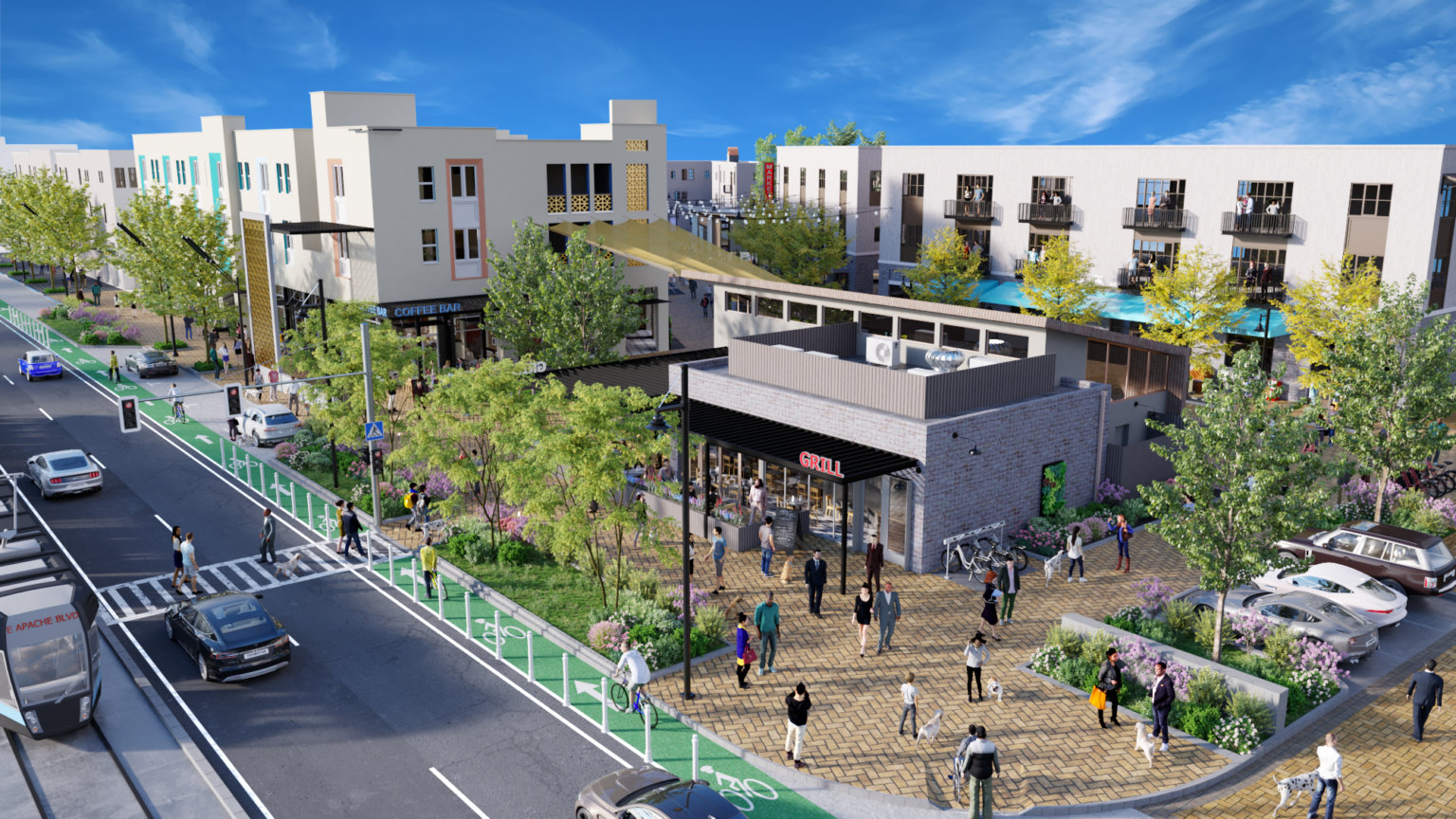
Tempe Arizona, “The post-car real estate development company known as Culdesac approached Opticos Design to apply their expertise in walkable communities and Missing Middle Housing to the first car-free neighborhood designed for shared mobility and built from scratch in the United States… “ …” Read more Hmmmm… . OK Tell me more… In Arizona none the less. However, the image does show a bunch of cars. 😎 Alain
NASA RAM Report – The Foundation for a Rural Air Revival
K. Pyle, June 17, “As with so many of the developments in telecom and broadband, rural areas may provide the proving ground for the next generation of air travel. This is one of the important implications of NASA’s recently issued report, Regional Air Mobility (RAM).
                                                      Investors,
                                                      community
                                                      leaders,
                                                      policymakers,
                                                      industry, and
                                                      the general
                                                      public are the
                                                      target
                                                      audience for
                                                      this aptly
                                                      named report.
                                                      Although
                                                      published by
                                                      NASA, the
                                                      authors hail
                                                      from academia,
                                                      the aviation
                                                      industry,
                                                      capital
                                                      markets, and,
                                                      of course,
                                                      NASA. In
                                                      short, the
                                                      report shows
                                                      how the
                                                      nation's
                                                      existing 5,000
                                                      airfields
                                                      provide a
                                                      launching
                                                      point for
                                                      low-cost
                                                      electric
                                                      aviation..."
                                                      [Read more](https://viodi.com/2021/06/17/nasa-ram-report-the-foundation-for-a-rural-air-revival/) Hmmmm...
                                                      . We can't be
                                                      left behind
                                                      here.  Why
                                                      not??? Alain
C’mon Man!(These folks didn’t get/read the memo)
Sunday Supplement
Half-Baked
Click-Bait
More On….
Re-see: Pop Up Metro USA Intro 09 2020
H. Poser’77, Sept 13, 2020. “Creating Value for Light Density Urban Rail Lines” . See slides, See video Hmmmm… Simply Brilliant. Alain
4thAnnual PrincetonSmartDrivingCar Summit It is over!!! Now time to actually do something in the Trentons of this world.
Making Driverless Happen: The Road Forward (Updated)
K. Pyle, April
18, "It's time
to hit the
start button,"
is [Fred Fishkin's](https://www.techstination.com/) succinct
way of
summarizing
the next steps
in the Smart
Driving Car
journey.
Fiskin, along
with the LA
Times' [Russ Mitchell](https://twitter.com/russ1mitchell?lang=en) co-produced
the final
session of
the [2021 Smart Driving Car Summit, Making It Happen: Part 2](https://orfe.princeton.edu/conferences/sdc/session/20210415).
This 16th and
final session
in this
multi-month
online
conference not
only provided
a s[ummary of the thought-provoking speakers](https://viodi.com/2021/04/18/making-driverless-happen-the-road-forward/),
but also
provided food
for thought on
a way forward
to bring
mobility to
"the Trentons
of the World."
Setting the
stage for this
final session,
Michael Sena
provided
highlights of
the Smart
Driving Car
journey that
started in
late December
2020. Safety,
high-quality,
and affordable
mobility,
particularly
for those who
do not have
many options,
was a common
theme to the
2021 Smart
Driving Car
Summit. As
Princeton
Professor
Kornhauser,
the conference
organizer put
it,....." [Read more](https://viodi.com/2021/04/18/making-driverless-happen-the-road-forward/) Hmmmm.... We had another
excellent
Session.
Thank you for
the summary,
Ken! Alain
Ken Pyle’s Session Summaries of 4th Princeton SmartDrivingCar Summit:
14th Session What Will Power Safely-driven Cars
13th Session Improving the Moving of Goods
12th Session 3/18/21 Human-centered Design of Safe and Affordable Driverless Mobility
11th Session 3/11/21 Incentivizing Through Regulation
10th Session 3/04/21 Incentivizing Through Insurance
9th Session 2/25/21 Can Level 3 be Delivered?
8th Session 2/18/21 Who Will Build, Sell and Maintain Driverless Cars?
Michael Sena’s Slides, Glenn Mercer Slides
7th Session 2/11/21 Finally Doing It
6th Session 2/ 4/21 Safe Enough in the Operational Design Domain
5th Session 1/28/21 At the Tipping Point
4th Session 1/21/21 Why Customers are Buying Them
3rd Session 1/14/21 The SmartDrivingCars We Can Buy Today
2nd Session1/ 7/21 A Look into the Future1st Session:12/17/20Setting the Stage
Kornhauser & He, April 2021“Making it Happen: A Proposal for Providing Affordable, High-quality, On-demand Mobility for All in the “Trentons” of this World”
Orf467F20_FinalReport “Analyzing Ride-Share Potential and Empty Repositioning Requirements of a Nationwide aTaxi System” Kornhauser & He, March 2021 “AV 101 + Trenton Affordable HQ Mobility Initiative”
###
Calendar of Upcoming
Events
5th Annual Princeton SmartDrivingCar Summit
Fall 2021 Live in Person November 2 (evening) -> 4, 2021
On the More Technical Side http://orfe.princeton.edu/~alaink/SmartDrivingCars/Papers/
K. Lockean’s AV Research Group at U of Texas
and The SYMPOSIUM ON THE FUTURE NETWORKED CAR 2021 VIRTUAL EVENT
R. Shields, 22 - 25 March, “Recordings from the conference: Session 1 plus opening: (Regulatory): https://youtu.be/UcDC8gXiUFk
                                                      Session 2: ([Cybersecurity](https://youtu.be/ppp2hxlvebY)): [https://youtu.be/ppp2hxlvebY](https://youtu.be/ppp2hxlvebY)

                                                      Session 3: [(Automated Driving Systems](https://youtu.be/uL2dRHuX2Cc)): [https://youtu.be/uL2dRHuX2Cc](https://youtu.be/uL2dRHuX2Cc)

                                                      Session 4: [(Communications for ADS](https://www.youtube.com/watch?v=IFQcL6yfBso)) : [https://www.youtube.com/watch?v=IFQcL6yfBso](https://www.youtube.com/watch?v=IFQcL6yfBso) [Read more](https://www.itu.int/en/fnc/2021/Pages/default.aspx)  Hmmmm...
                                                      Russ, thank
                                                      you for
                                                      sharing!
                                                      Alain
###
These editions re sponsored by the SmartETFs Smart Transportation and Technology ETF, symbol MOTO. For more information head to www.motoetf.com
SmartDrivingCars Pod-Cast Episode 231, Zoom-Cast Episode 231 w Michael Sena, Creator of The Dispatcher
###
F. Fishkin, Aug 27, “What’s wrong with the concept of building electric vehicles on a skateboard type platform? Consultant and The Dispatcher publisher Michael Sena joins Princeton’s Alain Kornhauser and co-host Fred Fishkin for that…plus Tesla, Waymo and more. And the next Princeton Smart Driving Cars Summit is on the way. Watch or listen…and subscribe! Or listen.”
SmartDrivingCars Pod-Cast Episode 230, Zoom-Cast Episode 230 w/Tim Higgins, author: POWER PLAY: Tesla, Elon Musk and the Bet of the Century
###
F. Fishkin, Aug 21, “Teslas, Humanoids and Elevators! What Elon Musk and Tesla delivered at AI Day 2021 was insight into the company’s remarkable technology and that may boost recruiting efforts. So says Princeton’s Alain Kornhauser who is joined by co-host Fred Fishkin and guest Tim Higgins of the Wall Street Journal, author of POWER PLAY… Tesla, Elon Musk and the Bet of the Century. AI Day, the NHTSA investigation and Elon Musk hops on the elevator on Episode 230 of Smart Driving Cars!
                                                      Or you can
                                                      listen to
                                                      Episode 230 of
                                                      Smart Driving
                                                      Cars on
                                                      Tesla's AI Day
                                                      and more with
                                                      guest Tim
                                                      Higgins of the
                                                      Wall Street
                                                      Journal
                                                      ..author of [POWER PLAY... Tesla, Elon Musk and the Bet of the Century](https://anchor.fm/smartdrivingcars/episodes/Smart-Driving-Cars-Episode-230-Teslas--Humanoids-and-Elevators-e168g34).
SmartDrivingCars Pod-Cast Episode 229, Zoom-Cast Episode 229 w/Russ Mitchell, Los Angeles Times
F. Fishkin, Aug 18, “With the National Highway Traffic Safety Administration having opened an investigation into Tesla autopilot crashes involving emergency vehicles…Los Angeles Times reporter Russ Mitchell joins Princeton’s Alain Kornhauser and co-host Fred Fishkin for a look at the issues facing Tesla and other vehicle makers.”
SmartDrivingCars Pod-Cast Episode 228, Zoom-Cast Episode 228 Planes, Trains & Automobiles
F. Fishkin, Aug 13, “Planes, trains and automobiles. From battery powered electric light rail to the confusion over the difference between driver assistance and self driving to Amazon’s new 1.5 billion dollar U.S. air cargo hub…the focus is on the latest in mobility. Join Princeton’s Alain Kornhauser and co-host Fred Fishkin for episode 228 of Smart Driving Cars. “
SmartDrivingCars Pod-Cast Episode 226, Zoom-Cast Episode 226 w/Tim Higgins, author: POWER PLAY: Tesla, Elon Musk and the Bet of the Century
###
F. Fishkin, July 22, “The Wall Street Journal’s Tim Higgins has a new book arriving August 3rd titled POWER PLAY: Tesla, Elon Musk and the Bet of the Century. You can bet it’s a lively discussion with Tim on the latest Smart Driving Cars with Princeton’s Alain Kornhauser & co-host Fred Fishkin. Or listen.. https://soundcloud.com/smartdrivingcar/smart-driving-cars-226-with-tim-higgins-author-of-power-play.
SmartDrivingCars Pod-Cast Episode 225, Zoom-Cast Episode 225 w/Kevin Biesty, Deputy Director for Policy @ Arizona DoT
F. Fishkin, July 22, “Chandler, Arizona is the one place where paying customers can take advantage of driverless robo-taxis (from Waymo) to get where they are going. How did that happen? What does the future hold? Kevin Biesty, Arizona’s Deputy Director for Policy at the Department of Transportation, joins Princeton’s Alain Kornhauser & co-host Fred Fishkin for an in depth discussion. Plus.. Ford, Argo, Lyft, Tesla, Mercedes & more. “
SmartDrivingCars Pod-Cast Episode 224, Zoom-Cast Episode 224 w/Selika Josiah Talbot, Principal, Autonomous Vehicle Consulting
F. Fishkin, July 19, “Does there need to be a White House appointed autonomous and electric vehicle czar to open up new mobility possibilities for all? That’s the view of Selika Josiah Talbott..a government veteran who now heads Autonomous Vehicle Consulting and lectures at American University. She joins Princeton’s Alain Kornhauser & co-host Fred Fishkin for a deeper look at how the technology can be deployed to improve lives.
SmartDrivingCars Pod-Cast Episode 223, Zoom-Cast Episode 223 w/Richard Mudge, Compass Transp. & Baruch Feigenbaum, Reason Foundation
F. Fishkin, July 15, “Can Tesla (and others) make automatic emergency braking work? Princeton’s Alain Kornhauser continues his push and is joined by the Reason Foundation’s Baruch Feigenbaum and Compass Transportation & Technology President Dick Mudge along with co-host Fred Fishkin to explore this week’ss Transportation Research Board sessions. “
SmartDrivingCars Pod-Cast Episode 222, Zoom-Cast Episode 222
F. Fishkin, July 11, “Is it time for autopilot to not break the law? Princeton’s Alain Kornhauser says yes. And if technology can save lives, prevent injuries and crashes shouldn’t it? Plus Richard Branson, Jeff Bezos, Waymo, VW and more on Episode 222 of Smart Driving Cars with co-host Fred Fishkin. “
SmartDrivingCars Pod-Cast Episode 221, Zoom-Cast Episode 221 w/Mark Rosekind, Chief Safety Innovation Officer, Zoox
F. Fishkin, July 1, “With Zoox the Amazon owned autonomous mobility company out with a comprehensive safety report.. Chief Safety Innovation Officer Dr. Mark Rosekind joins Princeton’s Alain Kornhauser and co-host Fred Fishkin. What is so different about the Zoox approach to building a vehicle and safety? What is the company’s vision for future mobility and transportation. Dr. Rosekind fills us in on those issues and more.
SmartDrivingCars Pod-Cast Episode 220, Zoom-Cast Episode 220 w/John Thornhill, Innovation Editor, Financial Times
F. Fishkin, July 1, “Sociology not technology will decide the electric car race. That’s a Financial Times headline from a piece written by Innovation Editor John Thornhill…who joins Princeton’s Alain Kornhauser and co-host Fred Fishkin for a lively discussion on that…plus Tesla…autonomous mobility and more. John is also the founder of Sifted.eu.
SmartDrivingCars Pod-Cast Episode 219, Zoom-Cast Episode 219 w/Michael Sena, Editor, The Dispatcher
F. Fishkin, June 29 , “Why couldn’t a smart driving car prevent Alain’s crash with a deer? How important is exact location for highly automated driving? And NHTSA wants reports on all automated vehicle system crashes. The Dispatcher publisher Michael Sena joins Princeton’s Alain Kornhauser and co-host Fred Fishkin for that and more.
SmartDrivingCars Pod-Cast Episode 218, Zoom-Cast Episode 218 w/Xinfeng Le, Waymo Product Manager
F. Fishkin, June 10 , “Have questions about Waymo’s partnership with JB Hunt to test autonomous trucks in Texas? So do we and Waymo’s Product Manager, Xinfeng Le joins Princeton’s Alain Kornhauser & co-host Fred Fishkin to provide answers. Plus.. Waymo raises 2 and a half billion dollars, MacKenzie Scott gives away billions, start-up Waabi comes out of stealth, Argo AI plans an IPO and more. “
SmartDrivingCars Pod-Cast Episode 217, Zoom-Cast Episode 217 w/Christorpher Mims, Columnist, Wall Street Journal
F. Fishkin, June 7 , “Are self-driving cars still decades ahead? Wall Street Jopurnal columnist and author Christopher Mims joins Princeton’s Alain Kornhauser & co-host Fred Fishkin for a look at the progress and roadblocks. Plus the latest on Tesla, Cruise, the dramatic rise in road deaths during Covid and more. “
SmartDrivingCars Pod-Cast Episode 216, Zoom-Cast Episode 216 w/Michael Sena, editor The Dispatcher
F. Fishkin, May 28 , “The Future of Mobility is Slowly Coming Into Focus. That’s on top in the June edition of The Dispatcher. From Sweden, publisher Michael Sena joins Princeton’s Alain Kornhauser and co-host Fred Fishkin for that plus better batteries, May Mobility, Tesla and more.
SmartDrivingCars Pod-Cast Episode 215, Zoom-Cast Episode 215 w/Cade Metz, Correspondent, NY Times & Ken Pyle, editor, Viodi.com
F. Fishkin, May 27 , “The Costly Pursuit of Self Driving Cars Continues On and On and On. That’s the headline of a NY Times story this week. The reporter, Cade Metz, also the author of a new book on artificial intelligence, joins Princeton’s Alain Kornhauser, co-host Fred Fishkin and guest Ken Pyle of Viodi View..”
SmartDrivingCars Pod-Cast Episode 214, Zoom-Cast Episode 214
F. Fishkin, May 23 , “An interview with the chief engineer behind Ford’s F150 Lightning EV truck…Waymo shares rider stories and the AFL-CIO tells Congress autonomous vehicles should be required to have human operators. Join Princeton’s Alain Kornhauser and co-host Fred Fishkin for those stories and more.”
SmartDrivingCars Pod-Cast Episode 213, Zoom-Cast Episode 213 w/Robbie Diamond; Founder, Securing America’s Future Energy
F. Fishkin, May 14 , “The autonomous mobility competition with China. What will it take to succeed? Securing America’s Future Energy founder Robbie Diamond dives in with Princeton’s Alain Kornhauser & co-host Fred Fishkin. Plus the latest on #AutoX, #Tesla, #GM, #TuSimple and more. Remember to subscribe! And check out this SAFE panel discussion too. “..
SmartDrivingCars Pod-Cast Episode 212, Zoom-Cast Episode 212 w/Ken Pyle
F. Fishkin, May 8 , “Where does Waymo go from here? Is GM really going to market personal autonomous vehicles? Viodi View managing editor Ken Pyle joins Princeton’s Alain Kornhauser & co-host Fred Fishkin for a look at those issues plus Volkswagen, Tesla, Argo and more.
SmartDrivingCars Pod-Cast Episode 211, Zoom-Cast Episode 211 w/ Michael Sena, Editor of The Dispatcher
F. Fishkin, May 1 , “There’s plenty of combustion around the issue of banning internal combustion engines (ICE). Consultant and The Dispatcher publisher Michael Sena joins us for a look at what makes sense…and what doesn’t. Plus #Tesla,#Toyota, #Volkswagen, #Baidu and progress in Florida. …”
SmartDrivingCars Pod-Cast Episode 210, Zoom-Cast Episode 210 w/Ken Pyle & Louis Aaron’23
F. Fishkin, April 26 , “Passengers at the Las Vegas Convention Center are about to get their first taste of the new underground mobility service from Elon Musk’s The Boring Company. Princeton student Louis Aaron has been working there and he joins Viodi View Managing Editor Ken Pyle, Princeton’s Alain ..”
SmartDrivingCars Pod-Cast Episode 209, Zoom-Cast Episode 209 w/Clifford Winston, Brookings Inst.
F. Fishkin, April , “The Texas #Tesla crash that killed two continues to make headlines. The impact on the electric and automated vehicle industries? From the Brookings Institution, senior fellow Clifford Winston joins Princeton’s Alain Kornhauser and co-host Fred Fishkin for a look at what the real focus should be on..”
SmartDrivingCars Pod-Cast Episode 208, Zoom-Cast Episode 208 w/Prof. Stephen Still, U. of Buffalo
F. Fishkin, April 18, “What does it take to bring about mobility for all in the real world? With help from the federal DOT and a team at the University of Buffalo…some big steps are being taken there. Professor Stephen Still joins Princeton’s Alain Kornhauser and co-host Fred Fishkin for that…plus, Tesla, Uber, Cruise and more on Smart Driving Cars.”
SmartDrivingCars Pod-Cast Episode 207, Zoom-Cast Episode 207 w/Selika Josiah Talbott
F. Fishkin, April 10 , “When a driverless vehicle crashes…what should passengers, other vehicle owners, law enforcement and first responders do? American University Professor Selika Josiah Talbott says the time for planning is now. She joins Princeton’s Alain Kornhauser and co-host Fred Fishkin for that plus Tesla, Apple and more in the latest Smart Driving Cars.”
SmartDrivingCars Pod-Cast Episode 206, Zoom-Cast Episode 206 w/Stan Young, National Renewable Energy Laboratory
F. Fishkin, April 2, “When it comes to future mobility, what will fuel the vehicles? How can the shortcomings of electric vehicles be overcome? Stanley Young, Mobility Systems team lead for the National Renewable Energy Laboratory joins Princeton’s Alain Kornhauser & co-host Fred Fishkin…”
SmartDrivingCars Pod-Cast Episode 205, Zoom-Cast Episode 205 w/Michael Sena; Editor The Dispatcher. President, MLSena Consulting
F. Fishkin, March 26, “Every driverless car should take the same tests that we take..and have the same responsibilities. So says Michael L. Sena in the latest edition of The Dispatcher. He joins Princeton’s Alain Kornhauser and co-host Fred Fishkin for that plus the latest from Tesla and more…on Episode 205 of Smart Driving Cars…”
SmartDrivingCars Pod-Cast Episode 204, Zoom-Cast Episode 204 w/Andrew Rose, President, OnStar Insurance Services
F. Fishkin, March 15, “.With GM aiming to upend the car insurance industry, the President of the automaker’s new OnStar Insurance Services, Andrew Rose joins Princeton’s Alain Kornhauser and co-host Fred Fishkin. What advantages will OnStar insurance bring to the table…and a look at the future of auto insurance..”
SmartDrivingCars Pod-Cast Episode 203, Zoom-Cast Episode 203 AV 101: A. Kornhauser F. Fishkin, March 13, “.GM’s move to transform auto insurance through OnStar Insurance: Is it a win, win for all? Is adaptive cruise control prompting some drivers to speed? And what does Tesla really mean by “full self driving”? Just some of the questions tackled in the latest edition of Smart Driving Cars with Princeton’s Alain Kornhauser & co-host Fred Fishkin.” SmartDrivingCars Pod-Cast Episode 202, Zoom-Cast Episode 202 President & CEO, RoadDB
F. Fishkin, March 3, “When will we be able to purchase cars that can largely drive themselves? It may not be long…but don’t expect to vacate the driver’s seat. That’s the view of entrepreneur, tech pioneer and RoadDB CEO Russ Shields. He takes an in depth look at where we are and where we’re headed with Princeton’s Alain Kornhauser & co-host Fred Fishkin.” SmartDrivingCars Pod-Cast Episode 201, Zoom-Cast Episode 201 w/Michael Sena, Publisher of The Dispatcher
F. Fishkin, Feb. 26, “Smarter cars need smarter assembly…and location matters. The Dispatcher publisher Michael Sena joins Princeton’s Alain Kornhauser and co-host Fred Fishkin for a look at that, politics, climate and carmakers…plus Tesla, Velodyne, Foxconn and more..” SmartDrivingCars Pod-Cast Episode 200, Zoom-Cast Episode 200 w/Edwin Olsen, CEO, May Mobility F. Fishkin, Feb. 22, “How May Mobility is building confidence in autonomous transportation and creating a road map for growth through the pandemic and beyond. CEO and co-founder Edwin Olson joins Princeton’s Alain Kornhauser and co-host Fred Fishkin for that and more.”
Link to previous SDC PodCasts & ZoomCasts
Recent Highlights of:
###
                                                      August 27,
                                                      2021
                                                      blue;
                                                      text-decoration:
                                                      none;">

                                                      [Not So Easy to Pop a Top Hat on a BEV Skateboard, plus more](https://www.dropbox.com/s/jaau5r3mbqetqoj/The-Dispatcher_September-2021.pdf?dl=0)
M. Sena, Issue (08-10) , Aug. 25,” Some of you are fans of Douglas Adamsand will enjoy this month’s Musings. Sometimes a little humor helps to get a serious point across better than trying to be seriously persuasive.
                                                      The lead
                                                      article in
                                                      this issue is
                                                      the first part
                                                      of a two-part
                                                      series. This
                                                      month I
                                                      discuss why
                                                      there is still
                                                      a chance for
                                                      the Western
                                                      automotive
                                                      OEMs to stay
                                                      in the game of
                                                      manufacturing
                                                      cars, rather
                                                      than being
                                                      relegated to
                                                      assemblers of
                                                      battery
                                                      electric
                                                      vehicle
                                                      components.
                                                      Next month I
                                                      examine why
                                                      the position
                                                      they have held
                                                      for the past
                                                      century, King
                                                      of the Hill,
                                                      is about to be
                                                      challenged.

                                                      In the second
                                                      article is
                                                      focused on the
                                                      need for
                                                      cooperation
                                                      between robot
                                                      and driver in
                                                      highly
                                                      automated
                                                      driving. If
                                                      Tesla had done
                                                      a better job
                                                      on this score
                                                      it could have
                                                      avoided being
                                                      called on the
                                                      carpet by the
                                                      National
                                                      Highway
                                                      Traffic Safety Administration. We'll see where that leads.

                                                      Dispatch
                                                      Central, as
                                                      usual,
                                                      attempts to
                                                      have something
                                                      for everyone.
                                                      I've called
                                                      the European
                                                      Commission out
                                                      for a major
                                                      miss in its
                                                      intelligent
                                                      speed
                                                      assistance
                                                      regulation,
                                                      not for
                                                      passing it but
                                                      for not making
                                                      it as robust
                                                      as it should
                                                      be.

                                                      Yes, I did use
                                                      these summer
                                                      months to
                                                      start work on
                                                      a follow-up to
                                                      the Princeton SmartDrivingCars Summit, and I did enjoy a very pleasant summer here in
                                                      Sweden. I hope
                                                      you enjoyed
                                                      your summer as
                                                      well wherever
                                                      and however
                                                      you spent it.
                                                      M. Sena"
Read more Hmmmm… Enjoy & Learn this month’s Dispatcher ( especially how to “… turn… pig’s ear into a silk purse…; no-brainers (P. 17); Some interesting Statistics on World energy & BEVs (P.18, thank you Fred Dryer), a possible upside for coal mines (P. 19), why ‘Level 3’ is even less probable than ‘Level 5’ which is reached only ‘in the limit as time goes to infinity’ and Evolutionary Domesticity (P. 29) and the answer is ‘42’ ! Listen/watch to the Pod/Zoom-Cast 231 with Michael, Fred and me centered on this issue. Alain
                                                      August 20,
                                                      2021
                                                      blue;
                                                      text-decoration:
                                                      none;">
Grizzly Research, Aug 10, “ TSP is the one of the latest hot China based IPO of an ambitious autonomous driving technology company, but we believe the company has systematically lied and misrepresented key information. …“ Read more Hmmmm… Devastating. Grizzly is focused on the short side, so read carefully. Bias may exist here.
My “back of the envelope”: Looks like TuSimple is expecting $0.35/mile revenue for their AV stack on Class 8 trucks. This is 50% of professional driver costs. Fine if you can eliminate the driver. Not so fine if an attendant is still there.
No way anyone can really begin to eliminate a driver on any stretch of the US interstate highway system for at least 2 years where there is any substantial volume of trucks. The “2 years” assumes that “attended” operation has encountered “few” disengagements, all of which have been appropriately resolved and there have been no “spectacular “ crashes by anyone involving Driverless Trucks in North America. (“Attended” means that there is at least one professional driver overseeing the “driverless” operation. “few”… you pick a number greater than zero. Disengagements… the professional driver intervened so as to avoid a “spectacular” crash. “Spectacular” crash is one that goes viral (Herzberg/Fukushima/Chernobyl/Diana). “2 years” … pick a number….)
Point is…, everyone is still in a substantial testing phase that has similar duration to Waymo’s/GM-Cruise/ Ford-Argo testing phases (5+ years) which necessarily precedes market introduction which then involves its own ramp-up phase (which hasn’t been going well for Waymo and the others haven’t even started.) So pick a number. During that time, TuSimple’s investors will need to pick up the tab for all of the people and all of the “liDars”, etc. used in testing and marketing initiatives before they can recognize any substantial $0.35/truck-mile revenue (minus any costs of the “AI-driver” software/sensor/processor/communications stack.. pick a number. In the initial ramp up of sales, this number can easily be greater than $0.35/mile).
TSP better be really good! Plus, they can’t afford any slip ups, nor have anyone else crash; else, Grizzly is going to do very well thank you. Alain
August 13,
2021 [CMU's Posner Lays Track for Future of Rail Transit](https://www.cmu.edu/news/stories/archives/2021/august/future-of-rail-transit.html) M
Henninger, Aug
11, "A bright
orange,
battery-powered
train breaks
the lush green
stillness of
Rockhill
Furnace,
Pennsylvania,
as it
traverses
track
originally
laid in 1876.
At the helm in
a bright
green/yellow
safety vest,
Meg Richards
tweaks the
throttle and
brakes as the
two-car train
passes by
baseball
fields,
crosses
streets and
completes the
day's test
run.
Along for the
ride, Henry
Posner III,
the chairman
of Railroad
Development
Corporation
(RDC) and an
adjunct
instructor at
Carnegie
Mellon
University,
sits eager to
demonstrate
his vision for
a rail-based
mass transit
system in the
United States.
The original
concept for
Pop-Up Metro —
a
battery-powered,
modular train
that can be
inserted onto
existing
infrastructure
— evolved in
parallel with
his Department
of History
class, The
American
Railroad-Decline
and
Renaissance in
the Era of
Deregulation.
"There are
more
possibilities
for railroads
than you might
think," said
Posner, who
together with
his wife,
University
Trustee Anne
Molloy, is
also a
generous
benefactor of
CMU. "A lot of
urban areas in
this country
have
underutilized
freight lines
that could
also support
transit
service.
People might
not have
considered
these
opportunities
because it's
been perceived
as too
expensive, too
lengthy and
too risky.
With Pop-Up
Metro, you can
do that
project
quickly on a
demonstration
basis. You
don't have to
spend $100
million."..."
[Read more](https://www.cmu.edu/news/stories/archives/2021/august/future-of-rail-transit.html)Hmmmm...
[Watch video](https://youtu.be/TSjAozf2r3g).
Fantastic for
those not
ready for
SmartDrivingCars
and those that
are, inducing
yours truly.
Alain
August 6, 2021
DECISION AUTHORIZING DEPLOYMENT OF DRIVERED AND DRIVERLESS AUTONOMOUS VEHICLE PASSENGER SERVICE CPUC, Nov 23, ‘20, “This decision creates two new autonomous vehicle programs that authorize fare collection (deployment programs), one for drivered autonomous vehicles and the other for driverless autonomous vehicles. Among other requirements, applicants to the existing driverless pilot program and the new driverless deployment program must submit Passenger Safety Plans that outline their plans to protect passenger safety for driverless operations.
                                                      In addition,
                                                      the decision
                                                      establishes
                                                      four goals
                                                      that apply to
                                                      both the
                                                      existing pilot
                                                      programs and
                                                      the new
                                                      deployment
                                                      programs; 1.)
                                                      Protect
                                                      passenger
                                                      safety; 2.)
                                                      Expand the
                                                      benefits of AV
                                                      technologies
                                                      to all of
                                                      Californians,
                                                      including
                                                      people with
                                                      disabilities;
                                                      3.) Improve
                                                      transportation
                                                      options for
                                                      all,
                                                      particularly
                                                      for
                                                      disadvantaged
                                                      communities
                                                      and low-income
                                                      communities;
                                                      and 4.) Reduce
                                                      greenhouse gas
                                                      emissions,
                                                      criteria air
                                                      pollutants,
                                                      and toxic air
                                                      contaminants,
                                                      particularly
                                                      in
                                                      disadvantaged
                                                      communities.
                                                      The Commission
                                                      will collect
                                                      data to
                                                      monitor permit
                                                      holders’
                                                      progress
                                                      toward each of
                                                      the goals...."
                                                      [Read more](https://www.dropbox.com/s/fiwy5ou01zo6tp6/CA%20PU%20Autonomous%20Vehicle%20Deployment%20Decision.PDF?dl=0) Hmmmm...
                                                      Sorry for not
                                                      reporting this
                                                      sooner, and
                                                      thank you Doug
                                                      Coventry for
                                                      bringing it to
                                                      my attention.
                                                      It is must
                                                       reading
                                                      for any
                                                      jurisdiction
                                                      making
                                                      regulations
                                                      regarding the
                                                      provision of
                                                      autonomousTaxi
                                                      mobility.
Its four goals are laudable, especially the 3rd, even if it may end up violating part of the 4th. Moreover, the clauses of the 3rd should be re-ordered to be: … Improve transportation options for disadvantaged communities, low income communities and those with disabilities, and, if possible, for all… This also reduces the goals to 3 important ones, … safety, the environment and improved mobility for those that have been left behind by the personal automobile
Of course, one wants to improve mobility for those that drive their own personal car; however, that is a entrenched well-served set of customers that are not readily going to flip from driving their car to something that isn’t really better and may largely be perceived as no cigar. Certainly, the public sector should in no way use public resources to give car drivers yet another good but inferior choice as was done with many public transportation investments that actually provide inferior mobility to those that were to be attract as customers. These systems are rebuffed by many that they were intended to be taken off the road for the trips they already make, let alone deliver quality-of-life benefits by providing mobility to new places that they couldn’t previously access.
A properly designed Operational Design Domain focused on from and where low income communities want to go is, to my mind, where the best opportunity exits for these safe, environmentally responsible systems . In such ODDs these driverless aTaxis can actually improve quality-of-life; and thus, deserve accommodation and promotion by public agencies such as CPUC. Alain
July 30, 2021
Nikola Founder Trevor Milton Charged With Lying to Investors C. . Ramey, July 29, “Trevor Milton, the founder of Nikola Corp. and onetime executive chairman of the electric-truck startup, was indicted Thursday on securities-fraud charges for what prosecutors said was a scheme to mislead investors about the company’s product and technology development.
Mr. Milton
faces two
counts of
securities
fraud and one
count of wire
fraud,
according to
the
indictment.
The U.S.
attorney's
office in
Manhattan,
which brought
the charges,
is set to make
an
announcement
about the
indictment on
Thursday
morning.
A spokesman
for Mr. Milton
didn't
immediately
comment. Last
year, Mr.
Milton said on
Twitter that
he intended to
defend himself
against "false allegations". [He resigned from Nikola in Septembe](https://www.wsj.com/articles/nikola-chairman-steps-down-as-company-faces-probe-11600672351?mod=article_inline)r
as [concerns mounted about the startup darling](https://www.wsj.com/articles/justice-department-probes-electric-truck-startup-nikola-over-claims-it-misled-investors-11600199462?mod=article_inline)that
had attracted
backing from
some of the
industry's
biggest names.
Nikola wasn't
charged. The
company said
that Mr.
Milton hasn't
been involved
in the
company's
operations or
communications
since his
resignation.
"Nikola has
cooperated
with the
government
throughout the
course of its
inquiry," the
company's
statement
said. "We
remain
committed to
our previously
announced
milestones and
timelines and
are focused on
delivering
Nikola Tre
battery-electric
trucks later
this year from
the company's
manufacturing facilities."Â..." [Read more](https://www.wsj.com/articles/nikola-founder-trevor-milton-charged-with-lying-to-investors-11627563648) Hmmmm... Speaks for itself. Alain
July 23, 2021
Upward Urban & Rural Mobility via Autonomous Mobility K. Pyle, July 19, “It is said that a picture is worth a thousand words. The picture Selika Josiah Talbott chose for her virtual backdrop at the recent 2021 TRB Annual Automated Road Transportation Symposium sums up the mobility challenges that urban and rural locales face with existing infrastructure, particularly in low-income areas. Joining Talbott on this panel were experts opining on Talbott’s insightful comments about autonomous mobility and its potential to provide upward mobility….” Read more Hmmmm… Simply a must read. This is the real market for autonomousTaxis (aTaxis). Alain
                                                      July 17, 2021    [2021 TRB Annual Automated Road Transportation Symposium](http://www.trb.org/Main/Blurbs/181880.aspx) July 12
                                                      -> 15,
                                                      "..."  [Read more](http://www.trb.org/Main/Blurbs/181880.aspx)  Hmmmm...I haven't been able to
                                                      find a public
                                                      source for any
                                                      of the content
                                                      from the
                                                      symposium but
                                                      there were at
                                                      least three
                                                      sessions (of
                                                      the few that I
                                                      was able to
                                                      attend) that
                                                      were really
                                                      good.  One
                                                      was [B-101- An inside Look at Policy-Making for Automated Vehicles](https://trb-arts.secure-platform.com/a/solicitations/73/sessiongallery/899),
                                                      moderated by
                                                      Baruch
                                                      Feigenbaum of
                                                      the Reason
                                                      Foundation.
                                                      Pay particular
                                                      attention to
                                                      the insights
                                                      offered by
                                                      Kevin Biesty
                                                      of Arizona
                                                      DoT.  So far,
                                                      no one in the
                                                      world has done
                                                      it better.
A second one was B204-Inclusive by Design: Creating an Equitable and Accessible Automated Future, moderated by Charlotte Frei.
The third was Richard Mudge’s B402- Shark Tank: Everything from Free Freight to AV for Low-Income Travelers to how many AV Firms will Survive?. (Spoil alert… the answer is . Selika Talbot’s presentation was absolutely fantastic. See PodCast/ZoomCast below for a discussion of parts of this session. Fred and I hope to do PodCasts/ZoomCasts with Selika and Kevin in the coming week.
Hopefully TRB will broadly distribute the recorded videos of these and the other sessions. One caution is that even in this community there is substantial confusion introduced over terminology which ends up having people talk by rather than with each other. This was an “Automated Road Transportation” symposium. One aspect of road transportation is the fundamental role of the human driver. It is very different than that of elevators that go from A to B without any direct human driver/operator intervention. The customer only tells the elevator what floor to go to. Everything else in the up/down mobility process is automated within the elevator’s Operational Design Domain (which is usually in a shaft, stooping only at designated stopping locations (floors) with centimeter accuracy but only when when sufficient power exists to perform the various operations. (Note: “Level 5 elevators” (operate under any power-available condition) will “never” exist.). It is easy for us to see the phenomenal difference in the societal value that can be achieved in elevators that deliver safe, shared-ride, on-demand 24/7 mobility, indiscriminately to essentially everyone. Unfortunately, precious little of that broad societal value can be achieved unless the elevator’s safe operation can be achieved without a human operator/driver.
This is a bang-bang situation. Either you have it or you don’t. Coming close doesn’t cut it.
It doesn’t mean that human operated elevators don’t deliver value to individual owners. My neighbor across the street has a dumbwaiter in her house that she and her husband control manually to move things including themselves up and down in their house. Works great. Real value. They both remain capable of performing the manual operations for themselves and if they charge themselves for the labor, they gain that charge so the transaction nets to zero labor cost. charge themselves . While some benefits (comfort & convenience) might be gained by them by automating some of the operating functions, full automation would be silly unless at least some number of neighbors would improve their quality-of-life if only they could easily go up and down in their house. That latent demand for improved quality-of-life does exist in tall buildings. It’s been consumed in a large part because elevators became operatorless and not just operator assisted. Shared and not quite door2door shortcomings are endured. 24/7, on-demand, affordable (especially for the rent payer on the “14th” floor. So much so that they just pick up the tab for the elevators that deliver accessibility to/from the “14th floor”) are the fundamental mobility attributes that totally dominate the competition for mobility afforded by the stairwell. Without the elimination of the operator/driver, the 24/7, on-demand, affordable trifecta is not deliverable to anybody.
Way too often during the Symposium automation that explicitly requires the continued presence of a driver and is only at best a comfort & convenience feature as ascribed benefits that accrue only for systems that achieve safe driverless operation. There is no getting away from it, automation that assist drivers is radically different than automation that replaces drivers. Hopefully next year we can have 2 AV conferences. One that focuses on automation to assist human drivers and one that focuses on technology and deployments that replaces the driver.
As far as connectivity goes, we need to realize that it is a nice2have, not a need2have. Since it can only deliver value among pairs of adopters, it struggles getting started by itself when it needs to find a partner. Unfortunately, road vehicles have performed well for more than 100 years without much connectivity and automation at this point is saying: you aren’t much help and we can’t afford to carry you along. Alain July 11, 2021
Tesla Says Autopilot Makes Its Cars Safer. Crash Victims Say It Kills. Neal Boudette, July 5, “ Benjamin Maldonado and his teenage son were driving back from a soccer tournament on a California freeway in August 2019 when a truck in front of them slowed. Mr. Maldonado flicked his turn signal and moved right. Within seconds, his Ford Explorer pickup was hit by a Tesla Model 3 that was traveling about 60 miles per hour on Autopilot.
A six-second video captured by the Tesla and data it recorded show that neither Autopilot, Tesla’s much-vaunted system that can steer, brake and accelerate a car on its own, nor the driver slowed the vehicle until a fraction of a second before the crash…“ Read more Hmmmm… A few comments here: 1. Because of the suit here, hopefully more of the data associated with this crash will be made public. Future crashes such as these seem to be covered by the recent NHTSA standing General Order requiring the data to be released without need of lawyers, assuming Tesla cooperates. 2. Neal (slightly) overstate his plot which clearly shows the Tesla began to decelerate slightly more than a full second before impact. He also doesn’t mention what the video clearly shows that the Tesla was “cut-off” by the pickup truck. More over the pickup applied its brakes as it was making the lane change (brake light came on). This brake application may well have been the critical element that made the crash unavoidable. AutoPilot was likely tacking the pickup from at least the 6 seconds before collision point. Tesla must have data on the relative longitudinal speed between the pickup and the Tesla.and it must also have an expected time-to-collision which is a critical measure as to when to kick in the Automated Emergency Braking System. Once again, my main concern here is not (yet) about the performance of AutoPilot, but the performance of Tesla’s Automated Emergency Braking System (AEBS). This is a rear-end crash. It is the responsibility of the AEBS to avert these crashes. Seems as if the AEBS did NOT properly anticipate the pick-up’s maneuver nor properly monitor time-to-collision. My recommendation here is to improve the AEBS.
3. Comments implying that radar would have been better at identifying the ‘cut-off’ are questionable. Lane intrusion is only partial until about 3 seconds before impact. Radar does not return lateral relative-speed, only longitudinal relative-speed. Who knows what lag exists in determining lateral speed and the accuracy of that determination. I doubt that either are very good web based on radar. My guess is that image processing at better than 20Hz would do best in this clear situation.
4. Interpretation of the turn signal can only be done with image processing (to my knowledge.)
5. Nothing is reported about any horn actuation (or if autoPilot even uses the horn). The brake application by the pickup may have been an impulsive response to a horn blow by the Tesla.
6. There seems to be no indication by the driver of the pick-up that he saw the Tesla coming.
7. The Tesla data likely also has its closing speed on the panel truck and thus the closing speed of the pick-up to the panel truck. This information may help us to begin to understand the extent to which the pickup was tailgating the panel truck. 8. To me, AutoPilot’s main issue is: should it allow “passing on the right” when “passing on the right” is illegal. The reason it is illegal is because it leads to crashes like this one, that is an issue that should be taken up by NHTSA and NTSB. To what extent should any of these automated driving devices engage in “illegal” driving? My current view (subject to change) is: a. Up to 9 mph over is OK. b. Rolling through a stop sign is OK, if it is determined that time to any likely collision is greater than 5 seconds (meaning you must be able to “see” at least 5 seconds away at speed limit +9 (or something similar)
c. Cross double line as long as oncoming traffic has slowed to under 25 mph and has room to proceed by squeezing right (or something like that).
d. Pass on the right as long as all pertinent vehicles in the two lanes are moving at less than 25 mph (or something like that).
Alain
June 28, 2021 [How Important is Exact Localization for HAD?](https://www.dropbox.com/s/e8ql7q722zxqb13/The-Dispatcher_July-2021.pdf?dl=0) M.
Sena,
July/Aug. '21,
"[In this issue of The Dispatcher for July and August](http://www.michaellsena.com/wp-content/uploads/2021/06/The-Dispatcher_July-2021.pdf), I
have taken up
a subject in
the lead
article that
has been on my
list for quite
some time. It
is of how cars
that drive
themselves
keep
themselves on
the road while
they make
their journey
to their
destination.
It turns out
that there is
a very good
reason why
Teslas crash
and Waymo is
running around
only in
Chandler,
Arizona after
people who
didn't know
better
promised that
there would be
completely
driverless
cars on all
roads a decade
ago:
localization
of a moving
vehicle is
very, very
hard, even for
a human.
I encourage
you to read
Musings this
month. It's
about making
the journey to
a world
without
climate change
protests, a
world where
they either
won't be
necessary or
allowed. On
most journeys,
we have to
cross bridges.
Sometimes we
have to make
them
ourselves.
Think of the
article as the
first bridge
to cross
toward a
better
understanding
of the climate
change
journey.
Dispatch
Central
contains, as
usual,
something for
everyone.
Insurance is
addressed in
the two main
articles. In
Bits and
Pieces I have
added my
thoughts on
recent events.
This is a
double issue,
in part
because we are
going to try
to do more
this summer
than we could
do last. But
it's also
because I need
some extra
time to work
on a follow-up
to the
Princeton SmartDrivingCars Summit with Professor Alain Kornhauser. There was a
concrete
proposal put
forward by
Professor
Kornhauser
during the
last session,
and many of us
who took part
in the Summit
have committed
to try to work
on
implementing
that
proposal. [Read more](https://www.dropbox.com/s/e8ql7q722zxqb13/The-Dispatcher_July-2021.pdf?dl=0) Hmmmm... . Once again an
outstanding The
Dispatcher.
I happen to
have a diffent
fundamental
view on"exact
localization" than Michael, many and possibly
even everyone
else... As
usual, I'll
take a very
self-centered
view... I've
lived my whole
life without
knowing (or
caring to
know) my
"exact
location".
I've been
satisfied to
know: "sort
of... where am
I?" but
exact...where
am I? ... not
so much.
What troubles
me about the
"exact where
am I" is that
this exactness
is in some
coordinate
system. Where
is the origin
of that
coordinate
system and is
moving? Oh,
it's the
"center" of
the earth??
Or some
"reference
point". So
"exact" is
actually,
"exact
relative to
some reference
point. Little
seems to ever
be said about
the
"exactness" of
the reference
point, but
that may
actually be
some saving
grace about
"exact".. it
is "exact"
relative to
some reference
point.
I see.. If the reference point is the center of the Universe, then I’d better be really-really precise; else, small small changes mean big-big differences. If the reference is the center of the earth, then I may just need to be really precise; else, small changes mean big differences. However, if the reference point is my nose and I’m trying to stay between two white lines and not hit anything, then the precision to which I need to know where things are may not need to be very precise as long as I have a little bit of leeway and still stay between the lines and leave enough room around the various objects to not hit them.
OK, safe driving requires only knowing where I am relative to objects around me to a moderate level of precision. I can do it in two ways… take the difference between two values: location of object and my location. The farther away the reference point, the more precise they will need to be if precision of the difference is to be maintained. Consequently, if the measurements are relative to my nose, the need for about as small as it can get.
Moreover, any precision data base lacks some “most” important values.. 1. a precise value for my location and 2. a precise value for anything around me that moves (meaning it wasn’t at its current location when the HD database was assembled). Required is the ability in real time to locate and track objects relative to me (my nose, the hood ornament of my car, ..) with only some precision These objects and their location aren’t included in these precise/HD databases. What is needed is a very reliable means of identifying objects and determining their position and velocity with little latency. This is absolutely necessary;uyr;y necessary for the moving objects, might as well do it also for the stationary objects. Alain
Please don’t suggest that one needs an HD map database in order to run their SLAM (Simultaneous Localization And Mapping) algorithm. That algorithm needs as input the relative position (sensor observations) of objects . The capability to determine those inputs is all that is needed to do collision avoidance, so don’t even bother going through the SLAM computation and certainly don’t pay for a reference data set.
                                                      May 29, 2021   [The Future of Mobility is Slowly Coming into Focus](https://www.dropbox.com/s/bpeklrq3sgutu1l/The-Dispatcher_June-2021.pdf?dl=0) M.
                                                      Sena, June
                                                      2021,
                                                      "...Mobility-as-a-service
                                                      would provide
                                                      the business
                                                      model to tie
                                                      everything
                                                      together,
                                                      perhaps as an
                                                      extension of
                                                      your
                                                      phone/broadband
                                                      subscription.
                                                      Private car
                                                      ownership
                                                      would soon be
                                                      a relic of a
                                                      bygone age.
This is an interesting narrative, but is not a correct one. Even before COVID-19 changed how people have been living outside of China since Friday, the 13th of March 2020, the picture of everything happening in high density cities was a rumor that companies like WEWORK spread to build their houses of cards. …
One effect of changes that have occurred in where people live and work in and around big cities is a phenomenon that was already well underway before the pandemic but has sped up: the demise of inner city buses. I wrote about this in the December 2018 issue of THE DISPATCHER, Is It Time to Throw the Bus Under the Bus?. I wrote:
                                                      We need to
                                                      start thinking
                                                      outside the
                                                      bus. If a city
                                                      is serious
                                                      about
                                                      providing a
                                                      useful bus
                                                      service, it
                                                      needs to run
                                                      them
                                                      everywhere and
                                                      often,
                                                      including at
                                                      night. It
                                                      must,
                                                      therefore, get
                                                      rid of cars
                                                      driving and
                                                      parking on its
                                                      streets. ..
One effect of changes that have occurred in where people live and work in and around big cities is a phenomenon that was already well underway before the pandemic but has sped up: the demise of inner city buses. I wrote about this in the December 2018 issue of THE DISPATCHER, Is It Time to Throw the Bus Under the Bus?. I wrote:
                                                      We need to
                                                      start thinking
                                                      outside the
                                                      bus. If a city
                                                      is serious
                                                      about
                                                      providing a
                                                      useful bus
                                                      service, it
                                                      needs to run
                                                      them
                                                      everywhere and
                                                      often,
                                                      including at
                                                      night. It
                                                      must,
                                                      therefore, get
                                                      rid of cars
                                                      driving and
                                                      parking on its
                                                      streets. ...
                                                      What cities
                                                      are doing
                                                      today all over
                                                      the world is
                                                      neither
                                                      providing an
                                                      adequate
                                                      service to
                                                      their citizens
                                                      nor using the
                                                      money
                                                      allocated for
                                                      transport in a
                                                      cost-effective
                                                      way...
Bite the bullet and get private cars off the big city streets
                                                      The reasons
                                                      that people
                                                      who live in
                                                      cities began
                                                      to buy cars
                                                      was that they
                                                      needed them to
                                                      get to their
                                                      jobs, the ones
                                                      that began
                                                      moving out of
                                                      the cities in
                                                      the campuses
                                                      where there
                                                      were no
                                                      transit links.
                                                      Then they
                                                      needed them to
                                                      drop off their
                                                      children to
                                                      day care
                                                      centers since
                                                      both parents
                                                      worked. Then
                                                      they needed
                                                      them to drop
                                                      off their
                                                      older
                                                      children...
As I said, it is not buses that will meet the need. Neither is it roads filled with taxis. There are taxis offering rides in Trenton and Scranton, but they are not replacing buses because they are too expensive and are often unavailable when demand for them is highest. The Uber/Lyft model can be better at meeting demand, but they are still too costly…”
Read more Hmmmm… Enjoy the whole issue. It is enormously well written! Also listen/watch the SDC Pod/Zoom Cast 216- below with Michael. Alain May 22, 2021
Why I Ride with Waymo: Mike Waymo One, May 13, “… I started taking it to work, and after crunching the numbers for gas, maintenance, insurance, upkeep, and owning a depreciating investment, it was pretty much a no-brainer that we really didn’t need two cars. I sold off my car and made Waymo my choice for commuting to and from work and for trips my wife and I need to take when the other is using our car…“ Read more Hmmmm…This is really great that he “crunched the numbers” and found it to be “pretty much a no-brainer”, which is what every real Waymo customer in Chandler has to do to become a Waymo customer. One “doesn’t move to Chandler unless one has “two cars”. See slide 5: 70% of the households have 2 or more cars in Chandler, so most of the folks have had to do the math to become a customer. If Waymo offered the same service in Trenton, where 70% of the households have at most one car and 30% don’t have any, then it doesn’t take much number crunching to appreciate Waymo when walking is the next best way to go.
The Chandler Operational Design Domain (ODD) may be a great place to get the technology working. It may well be the “easiest” ODD in the world. A Trenton ODD may well not be all that much more difficult technologically. What Trenton does have are customers for whom what Waymo can deliver is truly a no-brainer. Alain
                                                      May 8, 2021   [Why hasn't Waymo expanded its driverless service? Here's is my theory](https://arstechnica.com/cars/2021/05/why-hasnt-waymo-expanded-its-driverless-service-heres-my-theory/)
                                                      T. Lee, May 7,
                                                      "Suburban
                                                      ride-hailing
                                                      is a lousy
                                                      business to be
                                                      in.
Last October, Waymo did something remarkable: the company launched a fully driverless commercial taxi service called Waymo One. Customers in a 50-square-mile corner of suburban Phoenix can now use their smartphones to hail a Chrysler Pacifica minivan with no one in the driver’s seat.
And then...
nothing. Seven
months later,
Waymo has
neither
expanded the
footprint of
the Phoenix
service nor
has it
announced a
timeline for
launching in a
second city.
It's as if
Steve Jobs had
unveiled the
iPhone,
shipped a few
thousand
phones to an
Apple Store in
Phoenix, and
then didn't
ship any more
for months;
and wouldn't
explain why.
Last Friday,
two Waymo
employees [participated in an "ask me anything" thread](https://www.reddit.com/r/SelfDrivingCars/comments/n031vq/you_voted_and_were_excited_to_chat_about_waymo/) on
the
SelfDrivingCars
subreddit, a
watering hole
for
self-driving
industry
insiders.
Questions
about
expansion
plans
dominated the
conversation.
"How are you
going to
scale?" one
redditor
asked. "What
are the
impediments to
service
expansion at
this time?"
The Waymonauts
responded with
maddening
generalities.
"We feel the
same urgency
to scale
quickly that
others do, but
a ton of work
goes into
doing it
safely," wrote
Waymo's Sam
Kansara." [Read more](https://arstechnica.com/cars/2021/05/why-hasnt-waymo-expanded-its-driverless-service-heres-my-theory/) Hmmmm... Not at all surprising. Can you imagine trying to be
better than
one's own Land
Rover or
Porsche in car
country. That
is a heavy
lift. Making
it heavier is
the focus on
today's most
entitled
yuppies.
That's as bad
as the
original focus
of driverless
cars on
1%ers. Waymos
are pure and
simple
mobility
machines to
get you
from/to places
horizontally,
just as
elevators do
vertically ...
just get you
up to the "8th
floor". Why
are elevators
so successful
at what they
do?... Second
best is the
stairwell!
They win all
the time,
hands down.
In Chandler, the “stairwell” is your car parked in your garage. You don’t even have to go outside in all that heat. Waymo’s got to be really good to beat that! Waymo might end up getting close to that good, but in the beginning chances “slim-to-none”. Not that the car in the garage doesn’t have an enormous amount of “excess baggage”. Everyone seems to have conveniently forgotten about it. When even with all of its LiDars, radars and deepLearning, whereas the car with the Mad Men fantasies is way more than half full and your go-to mobility is your car. Your car allowed you to consider the Chandlers of this world as a place whee you want to live. That’s a challenging market place for Waymo. It’s worse than Bing v Google
A better place for Waymo ( or Ford/Argo or GM/cruise) the place to start is to focus on a market where they can easily deliver better service. The obvious market is to provide Waymo mobility to concentrations of households that have zero or only one car. Folks that have been left behind by the automobile and don’t have access to one. Those that have been relegated to take the staircase thereby not even having the opportunity to reach “the eighth floor”; which, once they can using Waymo, would substantially improve their lives. They might in fact appreciate Waymo right out of the box.
Manhattan is one such place, but it has a great subway and safely driving its roads is enormously challenging, so that’s arguably the last place for Waymo to go. However, the census identifies many communities and “inner suburbs” that have substantial densities of zero and one-car household. For example: Trenton New Jersey. Waymo would be the obvious mobility choice. Numerous Trenton residents would readily perceive Waymo as the “Google” in their trip mode-choice.
Another note… trying to sell Waymo technology on its ability to improve safety is a fool’s gambit. Since Waymos don’t misbehave, it is “easy” to make them safer, but that argument is hard to get across Misbehaviors are core to the fantasies of driving and are thus excused and forgotten about. Alain
Alain L. Kornhauser, PhD
Professor & Director of Undergraduate Studies, Operations Research & Financial Engineering
                                            Director, Transportation
                                            Program

                                            Faculty Chair, Princeton
                                            Autonomous Vehicle
                                            Engineering
229 Sherrerd Hall
                                                    Princeton
                                                    University

                                                    Princeton, NJ
609-980-1427 (c)